What Is the Difference Between Allotment and Possession?
In Pakistani property dealings, the words "allotment" and "possession" are often used as if they mean the same thing. They do not. One is a right recorded in a file. The other is the actual property in your hand. Confusing the two is one of the most common reasons buyers pay full price for something they cannot use, build on, or sell.
Allotment is the official confirmation that a plot, house, or unit has been assigned to a specific person in the records of a housing society or development authority. It is proved by an allotment letter and the society's member record. Possession is the physical handover of that property, proved by a possession letter and, in practice, by the buyer being able to stand on the plot, get it demarcated, and use it. A person can hold a valid allotment without possession, but possession without a valid allotment is a serious warning sign. When you buy, you should confirm both — and confirm that the seller's name appears in the society's own record, not just on a photocopied file.
The distinction matters most in housing societies, where a plot is usually allotted first and handed over later, sometimes years later. It also matters in development authority areas, where transfer and handover follow their own procedures. If you are buying in Multi Gardens B-17 (MPCHS), Faisal Hills, Faisal Margalla City, Faisal Town, or anywhere else in the Islamabad and Rawalpindi region, understanding this difference protects you from paying for the wrong thing.
What Allotment Actually Means
Allotment is the stage where a property is officially assigned to your name in the records. In a housing society, this usually follows a membership application, payment of the applicable charges, and — in some schemes — a ballot. The society then issues an allotment letter and enters the allottee's name against a specific plot number in its register.
What an allotment letter normally shows
The letter generally identifies the society or authority, the member or allottee's name, the membership number, the plot or unit number, the size and category of the property, and the payment terms attached to it. Some societies also mention the block or sector, the total price, and any conditions that must be met before possession can be handed over.
An allotment is a recorded right. It gives you a claim on that specific property in the society's books. But it does not automatically mean you can start construction, connect utilities, or occupy the property. Those usually come with possession.
Provisional allotment vs confirmed allotment
Many societies issue a provisional or temporary allotment first. This may be subject to clearance of pending payments, verification of documents, or approval by the society's management. A confirmed allotment comes after those conditions are met. If you are buying from a seller who holds only a provisional allotment, you should confirm in writing what remains outstanding and who is responsible for completing it.
What Possession Actually Means
Possession is the point at which the property is handed over to you in practical terms. The society or authority issues a possession letter, the plot is demarcated on the ground, dues are cleared, and you are free to use the property within the rules of that society or authority.
In practical terms, possession is what allows you to:
What Possession Normally Allows
- Take physical control of the plot or unit
- Apply for construction approval
- Start building, subject to society or authority rules
- Apply for utility connections where applicable
- Occupy the property yourself or rent it out
- Proceed with transfer formalities as per society rules
The exact rights attached to possession depend on the society or authority involved and the terms of the allotment. Some societies allow construction only after full payment; others allow it earlier. Always confirm the rules that apply to your specific property rather than assuming.
Paper possession vs physical possession
In practice, people in the market often talk about two kinds of possession. Paper possession means the society's record shows possession has been handed over, but the plot may still be undeveloped, undemarcated, or inaccessible. Physical possession means the plot exists on the ground, its boundaries can be identified, and you can actually access it.
This is why a possession letter alone is not enough. It should be backed by an actual visit to the site, confirmation of demarcation, and a check on whether the plot is free of encroachment or dispute.
Allotment vs Possession: The Key Differences
The table below summarises how the two stages differ in a typical housing society transaction.
| Point | Allotment | Possession |
|---|---|---|
| What it means | Property assigned to your name in the records | Property handed over for practical use |
| Main document | Allotment letter | Possession letter |
| Typical timing | Earlier in the process | Later, after dues and development |
| Level of control | Recorded right, limited use | Physical use and construction |
| Depends on | Membership, eligibility, payment, ballot | Cleared dues, demarcation, development |
| Main risk if unclear | Disputed or unconfirmed allocation | Paid for a plot you cannot use |
The simplest way to remember it: allotment answers "whose name is this plot in?" Possession answers "can I actually use it?"
Why the Difference Matters When You Buy
A plot with allotment but no possession and a plot with possession typically trade at different prices. Sellers know this. Some listings describe a file as if it were a ready plot, and buyers who do not ask the right questions end up paying a possession price for an allotment-only situation.
Before paying anything, ask the seller three direct questions:
First, is the property allotted in your name, and can the society confirm that in writing? Second, has possession been issued, and is it paper possession or physical possession? Third, are all dues, charges, and transfer fees cleared, or will they be deducted at transfer?
Example
Consider a buyer who purchases a plot described as "possession available" at a premium price. After payment, the buyer visits the site and finds the plot is still part of an undeveloped block with no clear access. The society's record shows possession on paper only. The buyer has a valid allotment in their name, but nothing they can build on — and the price they paid reflected physical possession, not paper possession.
Treat the seller's word and the file photocopy as a starting point, not proof. The confirmation that matters is the society's or authority's own record, checked independently. Our guide on how to verify property ownership in Pakistan explains how to approach that check.
Documents That Confirm Allotment and Possession
Different societies use slightly different paperwork, but the core documents are usually the same. Ask for originals, not photocopies, and verify each one against the society's record.
| Document | What It Confirms |
|---|---|
| Allotment Letter | Plot number, size, and allottee's name |
| Membership Record | Seller is a recognised member of the society |
| Payment Receipts | Which installments and charges have been paid |
| Possession Letter | Possession has been formally handed over |
| Dues Clearance / NDC | No outstanding society charges on the property |
| Transfer Letter | Society has approved the transfer into your name |
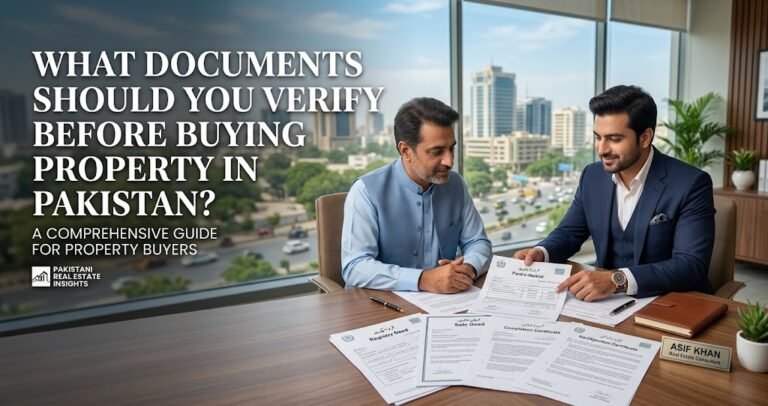
For properties outside societies — for example, revenue estate land or authority-approved urban property — the documents differ. There, a registered sale deed and mutation in the revenue record do the work that an allotment and transfer letter do in a society. Our page on documents to verify before buying property in Pakistan covers that side in more detail.
Practical Steps Before You Pay
The following checklist applies to most plot and file purchases in housing societies. Adjust it according to the specific society and the type of property involved.
Allotment and Possession Checklist
- Confirm the allotment in the society's own record
- Verify the seller's membership number and CNIC
- Match plot number and size against the approved layout plan
- Ask whether possession is paper or physical
- Obtain written confirmation of outstanding dues
- Confirm the transfer fee and who pays it
- Check the plot on the ground for access and encroachment
- Get any possession timeline in writing
- Have a lawyer review the documents before payment
- Pay through banking channels and keep every receipt
If the seller cannot produce the allotment letter, refuses a society confirmation, or asks you to rely on a general power of attorney instead of proper records, treat that as a reason to slow down. These are exactly the situations where buyers later discover that the allotment was never valid in the first place.
Common Mistakes Buyers Make
Most problems around allotment and possession come from a handful of repeated mistakes.
Assuming a file equals ownership. A file is a collection of papers. What matters is the society's record and whether the seller's name is entered there.
Paying a possession price for an allotment-only plot. If possession has not been issued, the value is different. Pay accordingly, or make the payment conditional on possession being issued.
Ignoring outstanding dues. Unpaid society charges can block transfer and possession. Get them confirmed in writing before you commit.
Relying on verbal promises about possession dates. If a timeline is promised, ask for it in writing as part of the agreement. Even then, treat timelines as expectations rather than guarantees.
Skipping the site visit. A plot can be allotted and even in possession on paper while being inaccessible, encroached upon, or different from what was described.
Local Considerations in Islamabad and Rawalpindi
In housing societies such as Multi Gardens B-17 (MPCHS), Faisal Hills, Faisal Margalla City, and Faisal Town, allotment, possession, and transfer are handled through the society's own office and records. Procedures, charges, and conditions can differ from one society to another, and they can change over time. Always confirm current requirements directly with the relevant society office before finalising a purchase.
In Islamabad, properties in CDA-administered areas follow a different route, where a No Demand Certificate and other authority requirements apply at the time of transfer. Buyers in these areas should confirm the current process with the relevant authority. Our guide on what to check before buying a house in Islamabad covers authority-related checks in more detail.
Families comparing society options often weigh access, facilities, and how developed each block actually is — which is closely tied to whether possession has been issued in that area. If you are considering B-17 in particular, this look at whether Multi Gardens B-17 is suitable for families may help. For plot-specific checks, see what to check before buying a residential plot.
Frequently Asked Questions
Is allotment the same as ownership?
Not exactly. Allotment confirms that a specific property has been assigned to a named person in a society's or authority's records. It is strong evidence of a right over that property, but it is not the same as a completed transfer. Until the transfer is recorded in your name and, where applicable, the deed is registered, the ownership position is not fully settled in your favour.
Can a plot be allotted without possession?
Yes, this is common. A society may allot a plot to a member long before the area is developed, demarcated, or cleared for handover. In such cases the member holds a valid allotment but has no physical possession, and cannot build or occupy until possession is issued.
What is the difference between a file and possession?
A file is the collection of documents relating to a property — allotment letter, receipts, membership papers, and so on. Possession is the actual handover of the property. A file can exist without possession, which is why buyers should never treat "file available" as equivalent to "plot ready to use".
How do I confirm possession before buying?
Ask for the possession letter, confirm with the society that possession has been issued in the seller's name, check that dues are cleared, and visit the site to confirm the plot exists, is accessible, and matches the documents. A possession letter without a site visit leaves too much unverified.
Does possession mean I can start construction?
Usually possession is a precondition for construction, but it is not the only one. Societies and authorities typically require approved building plans and clearance of dues before work begins. Confirm the specific requirements with the relevant society or authority before starting any work.
Who pays outstanding dues at the time of transfer?
This is a matter of agreement between buyer and seller, but it should always be settled in writing before payment. The safest approach is to obtain a written statement of dues from the society and agree clearly on who clears what, and by when.
Can possession be cancelled after it is issued?
Societies usually reserve the right to act where dues are unpaid, rules are violated, or allotment conditions are breached. The exact grounds and process are set out in each society's rules. Because these rules differ, confirm the position with the specific society rather than relying on general assumptions.
Final Thoughts
Allotment and possession are two different stages of the same journey. Allotment puts your name against a property in the records. Possession puts the property in your hands. A safe purchase confirms both, and confirms them through the society's or authority's own record rather than through a photocopy handed over in a meeting.
Whether you are buying a plot in Multi Gardens B-17 (MPCHS), Faisal Hills, Faisal Margalla City, Faisal Town, or anywhere else in Islamabad or Rawalpindi, the discipline is the same. Ask what stage the property is actually at, get it verified, and put the answers in writing before money changes hands.
If you would like help reviewing property documents or discussing a property requirement, you can contact GB BURKI Real Estate & Builders directly.

Ikram Ullah Barki
Ikram Ullah Barki is the founder of GB BURKI Real Estate & Builders and has been involved in the property business since 2011. His work focuses on property buying, selling, investment, and real estate opportunities across Islamabad and surrounding areas.
You can read more about his background on the Founder page, or explore property services offered by GB BURKI.
Get in Touch With GB BURKI
Call, WhatsApp, or email us for property guidance in Islamabad and Rawalpindi.
Need Help Checking a Plot or File?
Tell GB BURKI Real Estate & Builders about your property requirement. The team can help you understand what documents to check and review available options in Islamabad and Rawalpindi.