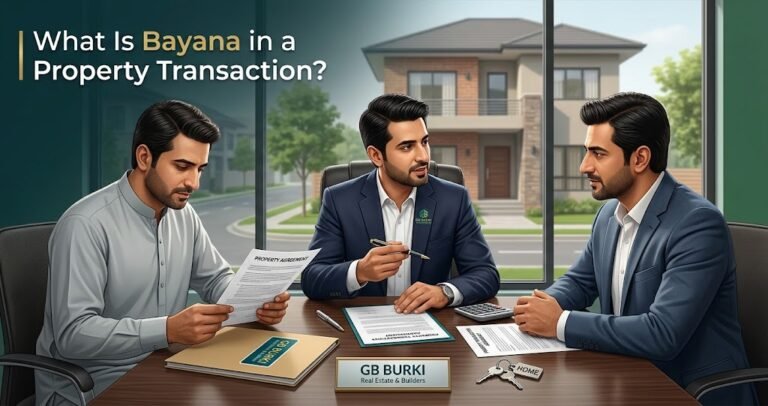
What Is a Property Token and Why Does It Matter?
In Pakistani property deals, the word "token" gets used a lot. A buyer pays a token to hold a plot, a seller accepts a token to show the deal is serious, and both sides move on to the next stage. But what exactly is a property token, and why does it matter so much? The amount is usually small, but the decision to pay it — and what you get in return — can shape the entire transaction.
A property token is a small advance payment made by a buyer to a seller to reserve a property for a short period. It signals that the buyer is serious and asks the seller to stop showing the property to others. Unlike bayana, which is a larger, formal part-payment documented in a written agreement, a token is usually a modest amount, often refundable if the buyer backs out after basic verification. The exact terms matter: a token paid without any written conditions is just money handed over. A token paid with a clear, signed receipt that states the price, the deadline, and the refund conditions is a useful step that protects both sides.
The confusion between token and bayana causes a lot of disputes. People use the words interchangeably, but they describe different stages and carry different legal weight. Understanding the difference helps you avoid paying a large sum for something that was only meant to be a small reservation fee.
What a Property Token Actually Does
A token is a reservation fee. When you pay it, the seller agrees to take the property off the market for a short time — usually a few days to a couple of weeks — while you complete your basic checks. During that window, the seller should not accept a better offer from someone else.
In practice, a token is used when a buyer is interested but not yet ready to commit to a full bayana. The buyer wants time to verify the documents, visit the site, or arrange funds. The seller wants some assurance that the buyer will not simply disappear. The token bridges that gap.
However, a token is not a legal transfer of any right. It does not give you ownership, possession, or even a guaranteed right to buy. It is a commercial understanding, and its enforceability depends almost entirely on what is written down.
Token vs Bayana: a quick comparison
| Feature | Token | Bayana |
|---|---|---|
| Purpose | Reserve the property temporarily | Formal commitment and part payment |
| Typical amount | Small, often a few thousand to a small percentage | Substantial, often 10% to 25% of price |
| Refundable? | Usually yes, if conditional and written | Depends on the agreement and reason for default |
| Documentation | Receipt or short written note | Written agreement on stamp paper |
| Legal weight | Limited; mainly a receipt | Can form a binding agreement to sell |
The key difference is intent. A token says, "I am interested; give me a few days." A bayana says, "I am committing; here is a significant part of the price." If you are asked to pay a large amount and told it is just a token, clarify whether it is really a bayana in disguise.
Why the Token Matters
The token matters because it is the first point where money changes hands. Once you pay, your position changes. You have some commitment on the table, and the seller has some obligation to hold the property. If the deal later falls apart, the token becomes the subject of the dispute.
A well-handled token protects both sides. The buyer gets time to do due diligence without the fear of losing the property to another buyer. The seller gets a signal that the buyer is serious and a small compensation if the buyer wastes their time.
A poorly handled token creates problems. If there is no written record, the buyer may struggle to prove they paid anything. If the terms are vague, the seller may refuse to refund. If the buyer pays a token without any verification, they may later discover the property has a title defect.
Before paying a token, at least confirm that the seller is the actual owner and that the property is free of obvious disputes. Our guide on how to verify property ownership in Pakistan explains the checks you can do quickly.
When Is a Token Refundable?
There is no single rule. It depends on what was agreed and written down.
If the token was paid on the clear understanding that it is refundable if the buyer changes their mind or finds a problem during verification, then the seller should return it. This is common when the token is small and the buyer has not yet committed to a full agreement.
If the token was paid as part of a conditional deal — for example, "refundable only if the documents do not match" — then the refund depends on whether that condition is met. If the condition is not met, the seller may be entitled to keep the token.
If there is no written agreement at all, the position is unclear. In practice, many sellers will return a small token if the buyer walks away quickly, but there is no guarantee. Without a written record, you are relying on goodwill.
Example
Consider a buyer who pays a token of a modest amount for a plot, with a written receipt that says the token is refundable if the buyer finds a documentary problem within seven days. The buyer then discovers that the plot's size on the society record does not match the seller's claim. Under the written terms, the buyer can ask for the token back, and the seller should return it. Without that written condition, the seller could argue that the token was non-refundable.
What to Put in a Token Receipt
Even a simple token should be documented. A short, signed receipt is enough to avoid most misunderstandings. It does not need to be a full legal agreement, but it should capture the basics.
Essentials of a Token Receipt
- Date of payment
- Names and CNIC numbers of buyer and seller
- Property description (plot or house number, society/area)
- Amount paid as token
- Agreed sale price (if already settled)
- Deadline for the next step (bayana or full payment)
- Refund conditions, if any
- Signatures of both parties
If the seller refuses to sign even a simple receipt, treat that as a warning sign. It suggests they may not be willing to be held to any terms. In that case, paying a token is risky.
Common Mistakes with Property Tokens
Most token disputes come from a few repeated errors.
Paying a token without any written record. A verbal token is very hard to prove. Always get a receipt.
Assuming the token is always refundable. It is not, unless the receipt or agreement says so. Clarify the refund conditions before paying.
Paying a large amount as a "token." If the amount is large, it is probably a bayana. Treat it with the same formality as a bayana.
Skipping basic verification. A token is meant to give you time to verify. Do not pay it and then fail to verify.
Missing the deadline. If the token is conditional on a next step by a certain date, missing that date can weaken your position. Mark the date and act before it passes.
Local Considerations in Islamabad and Rawalpindi
Token practices vary by area. In housing societies such as Multi Gardens B-17 (MPCHS), Faisal Hills, Faisal Margalla City, and Faisal Town, the token is often handled directly between buyer and seller, sometimes with the dealer's involvement. The society's own transfer rules may also affect what happens next.
In Islamabad, CDA-administered properties may require additional checks and clearances before transfer. A token can be a useful first step, but it should be followed by proper verification. For plot-specific guidance, see what to check before buying a residential plot.
Sellers preparing to list a property should also understand how a token fits into the process. Our guide on what property sellers should prepare before listing covers the seller's side.
Frequently Asked Questions
Is a property token refundable?
It depends on the terms. If the receipt or agreement says the token is refundable under certain conditions, then it is refundable when those conditions are met. If there is no written condition, the refund depends on the seller's willingness. Always clarify the refund position before paying.
What is the difference between token and bayana?
A token is a small reservation fee, usually refundable and documented with a simple receipt. Bayana is a larger, formal part-payment, often documented in a written agreement on stamp paper, and it carries more legal weight. For a detailed explanation, see our article on what bayana means in a property transaction.
How much should a token be?
There is no fixed amount. It is usually a small sum relative to the property price — enough to show seriousness but not so much that it becomes a major commitment. If the seller demands a large amount as a token, clarify whether it is actually a bayana.
Can I get a token back if I change my mind?
If the token receipt says it is refundable, yes. If it does not say so, the seller may refuse. In practice, many sellers will return a small token if the buyer walks away quickly, but you should not rely on that. Get the refund terms in writing.
What if the seller refuses to give a written receipt?
Do not pay the token. A seller who will not even sign a simple receipt is a risk. You have no proof of payment and no clear terms. Walk away and find a seller who is willing to document the arrangement.
Does paying a token guarantee I will get the property?
No. A token is a reservation, not a guarantee. The seller could still back out, though a written receipt may give you a claim for a refund or, in some cases, other remedies. To secure the property, you need a formal agreement and eventually a registered transfer.
Final Thoughts
A property token is a small step, but it sets the tone for the rest of the transaction. Paying a token without any written record leaves you exposed. Paying it with a clear receipt that states the amount, the property, the deadline, and the refund conditions protects both sides.
Whether you are buying in Multi Gardens B-17 (MPCHS), Faisal Hills, Faisal Margalla City, Faisal Town, or anywhere else in Islamabad or Rawalpindi, the same rule applies: document the token, verify the property, and involve a lawyer before you commit to a larger payment.
If you would like help reviewing a token receipt or discussing a property requirement, you can contact GB BURKI Real Estate & Builders directly.

Ikram Ullah Barki
Ikram Ullah Barki is the founder of GB BURKI Real Estate & Builders and has been involved in the property business since 2011. His work focuses on property buying, selling, investment, and real estate opportunities across Islamabad and surrounding areas.
You can read more about his background on the Founder page, or explore property services offered by GB BURKI.
Get in Touch With GB BURKI
Call, WhatsApp, or email us for property guidance in Islamabad and Rawalpindi.
Need Help with a Property Deal?
Tell GB BURKI Real Estate & Builders about your property requirement. The team can help you understand what documents to check and review available options in Islamabad and Rawalpindi.